Here's why Rajeev Srinivasan believes there will be nothing particularly positive about the prime minister's US visit.

Human Resource Development Minister Smriti Irani on Thursday rejected allegations that her ministry was trying to push books written by Hindutva ideologues, saying it will abide by "constitutional modalities" before taking any step.

The 2 countries signed 15 agreements including one on defence cooperation after Prime Minister Narendra Modi held 'productive discussions' with President Joko Widodo.

The moderator, at times, had a tough time in controlling Kaine and Pence.

However, he refrained from speaking on Mexican immigrants and also declined to repeat his frequent promise to force Mexico to pay for the wall.
Prime Minister Narendra Modi will visit Japan, a key strategic partner, next month as he embarks on a busy foreign travel schedule in coming months that will include Bhutan, Brazil and the US.
Prime minister-elect Narendra Modi's first official visit as head of government will likely be to Dhaka, where he is expected to sign the much-awaited Teesta water-sharing agreement with Bangladesh Prime Minister Hasina.
As investors try to second-guess the US Fed, corporate and election results could have a bearing on market direction

'What we are going to see is a large number of white collar jobs getting lost.' 'Job loss can drive people to depression, drugs, alcoholism and even suicide as there is no one to turn to when they are down.' 'There is no in-between now -- things go from a luxurious lifestyle to no lifestyle.'

Leading think tank discusses a likely Narendra Modi government and America's engagement with the man US once scorned. Aziz Haniffa reports
Investors are already factoring in the impact. The IT Index on the BSE exchange dipped 2.5 per cent, with Infosys, Wipro and TCS showing a decline.

'There were assurances that Jaish-e-Mohammad was being reined in as was the Lashkar-e-Tayiba, but Pakistan's security forces could not risk opening too many dangerous new fronts,' notes former foreign secretary Ambassador Shyam Saran, who has just returned from a visit to Lahore.

Devangshu Datta predicts the good, the bad and the ugly of currency trends for the coming year.

The Congress on Thursday dismissed Narendra Modi's attack on Prime Minister Manmohan Singh reminding him that the country has over two-and-a-half a dozen chief ministers and rejected as "tall talk" his challenge to Singh for a public debate on pressing issues.

'That an Indian can lead the world's top software company is an important milestone for Indian Americans and for America. But the larger message is for India itself: Imagine what Indians can achieve at home if they put their differences aside and start helping one another,' says Vivek Wadhwa.

Contracts with India-based domestic assistants for officials abroad have become a headache for the Indian government.

'Progress demands regular senior-level attention from American leaders.' 'A leaders' summit is great, but we need sustained engagement to continue to forge new agreements and find new areas of cooperation.'

In a significant departure from tradition, the United States has decided to host Prime Minister Narendra Modi by working out a "special gesture date" around the 69th Session of the United Nations General Assembly meeting that is scheduled to take place on September 26 in New York.
Around half of private hospitals and most of government hospitals in the country will have to close down in the next five years because of an acute shortage of nurses.

US President Barack Obama said there is natural convergence between India and the United States.
How the two South Asian neighbours will interact with each other in the coming months will be decided by the two prime ministers in Washington.

'Under Justice Gogoi's tenure, the Supreme Court has gone from an institution that was at least formally committed to the protection of individual rights as its primary task, to an institution that speaks the language of the executive, and has become indistinguishable from the executive,' warns Gautam Bhatia.

Tainted former Indian Premier League Commissioner Lalit Modi invoked the names of British royalty, including Prince Charles and his brother Andrew, while seeking his travel papers from the United Kingdom home office, according to a media report on Sunday.

The 30-share Sensex closed down 114 points at 28,622 and the 50-share Nifty ended down 37 points at 8,686.

The External Affairs ministry has launched a mobile application named 'MEAIndia'

The University of Northern Virginia has been asked to stop operations July 16 onwards because it has failed to get accreditation from the State Council of Higher Education for Virginia

'China's excessive military aid to Pakistan is the real elephant in the room as far as Sino-Indian relations are concerned. India should be confident enough to accept a degree of closeness between China and Pakistan, since China may wish to use this link for its foray into the Muslim world.' 'But the Chinese must be realistic enough to know that as time passes, the tactic of using Pakistan as a proxy to check India will yield diminishing returns. The US tried it for 60 years but failed, so will China,' says Colonel Anil A Athale (retd).

India's unusual tough stand on the arrest of its diplomat Devyani Khobragade has forced the United States to initiate an "inter-agency review" to look into the lapses that happened in the high-profile case that triggered an uproar in India and strained bilateral ties.

'After many rudderless years, India and Japan have prime ministers with a sense of purpose and direction,' says Brahma Chellaney.

On his recent visit to China, the President made eminently sensible suggestions to improve relations except that they can't work in the present atmosphere.

Budget will get a welcome reception from the international biz.

Finance Minister Arun Jaitley presented the Union Budget.
The 'Smart Cities' project is one that has faced many hurdles.

In an online chat with readers, NNS Chandra offered advice on how to pursue an education abroad.

Amidst fracas over the launch of his book in Mumbai, former Pakistan Foreign Minister Khurshid Mahmud Kasuri has said that he is optimistic about peace between India and Pakistan and called for Prime Minister Narendra Modi to take forward Atal Bihari Vajpayee's work towards that end.
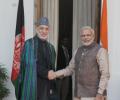
Security will be a consideration, as would protocol, but given Modi's penchant for the unconventional, it should not come as a surprise if he indeed decides to attend the ceremony in Kabul, says Ramesh Ramachandran.

Global investment is agnostic when it comes to nationalism, says Kanika Datta.

Thailand expressed interest in the Indian defence industry and its experience and expertise in the field of defence R&D and production. Modi welcomed Thai investments in India in the potential areas under the 'Make in India' initiative, especially in the manufacturing sector, infrastructure development, tourism and hospitality facilities.

Prime Minister Narendra Modi had gone to China with a bagful of initiatives, but not all seems to have been fulfilled given China's reluctance to go the whole hog with him
At no other time has a single meeting of the leaders of two democracies been so critical and hazardous.
